The Art of Medicine in Ancient Egypt James P Allen
Introduction
When studying the history of medicine, names such equally the Greek physicians Hippocrates (circa 460–circa 375 BCE) and Galen (129 CE–circa 216 CE) immediately come to mind. Modern medicine is indebted to the ancient Greeks, but it is equally important to report the development of medicine in the ancient Near East before the Hellenistic period. As this section will demonstrate, we are just as indebted to the ancient Egyptians equally nosotros are to the Greeks.
Medicine in ancient Egypt incorporated both conventional (rational) medicine and religious practices. Religion played a major part in aboriginal Egyptian daily life. There was an overlap between the priesthood and healers in addition to the frequent employment of incantations, amulets, and imagery related to deities such equally Horus and Seth.[1] The Egyptians' religious life and views helped shape their understanding of the human trunk, how information technology functions, and how to heal it.
Ancient Egyptians recognized wellness and illness as expressions of an individual's relationship with the world, which comprised people, animals, spirits, and gods.[2] Although they saw a stardom between the mundane/mortal and the supernatural/divine, they saw these worlds as oft interacting with one another. Maat (guild, residual, justice) was an integral part of this, governing people's actions and approaches to healing illnesses and injuries (fig. 1).
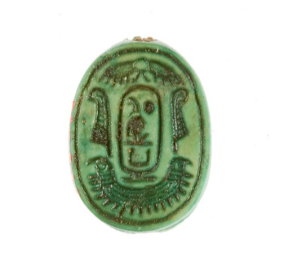 Figure 1. Scarab inscribed for Maatkare (Hatshepsut), New Kingdom, Eighteenth Dynasty (1479–1458 BCE). In the eye of the base of operations of the scarab in the cartouche is Hatshepsut's throne name, Maatkare (Hatshepsut was queen and later pharaoh during the Eighteenth Dynasty). Maatkare generally translates as "Maat is the life forcefulness of Re (the dominicus god)." On either side of the cartouche are feathers representing the goddess Maat (truth). Higher up the cartouche is a winged sunday deejay and below is a broad collar with falcon terminals. Steatite (glazed), i.viii × ane.3 cm (11/xvi × 1/two in.). New York Metropolitan Art Museum, Rogers Fund, 1927, 27.three.230.
One'southward adept health meant that maat was balanced, while affliction, injuries, and other issues indicated that maat was not in order. Health depended on this balance just like Egypt depended on the Nile River to maintain life.[3] Purity preserved maat and thus the body guided views on the human relationship between the mortal world and the divine. Existence pure was particularly important when one was coming into contact with the divine, including priests. To non be then could anger the gods.[iv] The swnw (conventionally pronounced every bit "sewnew"), wab priest, and sau were healers who focused either on the divine or mortal aspects of an disease or injury.[5] They turned to the religious thought that disease was a bulletin from divine entities with admission to heka (magic power). Symptoms were a upshot of a disturbance of maat, which could be repaired past heka, supplication, spells, and ritual.[6]
Much of what we know about aboriginal Egyptian medicine comes from human being remains, visual representation every bit seen in tombs and temples, among other places, and through written texts. The commencement of organized medical care and the evolution of Egyptian medical science may exist credited to Imhotep, during the reign of Pharaoh Djoser of the Tertiary Dynasty (circa 2686–2613, Quondam Kingdom). Clemens of Alexandria (150–215 CE) noted that this knowledge may accept existed much earlier with Athothis of the Offset Dynasty (circa 3100–2890); (son of Menes, the first pharaoh and who united Upper and Lower Egypt) and who may have authored a volume on anatomy.[7]
The Corpus of Medical Papyri
Much of what we know almost ancient Egyptian medicine has been preserved through several medical papyri. Many of the surviving papyri accept been plant in tombs. Before the discovery of these papyri, much of what nosotros knew was through the writings of individuals like Hippocrates, Homer, Herodotus, Pliny the Elder, and Diodorus.[viii] Although the papyri are in various states of preservation, they requite us valuable insight into the ancient Egyptians' knowledge of human being anatomy and physiology, ways of diagnosing illness and injuries, and how to treat medical bug using both rational medicine and magico-religious (a belief in supernatural beings) elements. Soon, there are at least xi known medical texts (in chronological lodge): the Kahun, Ramesseum, Edwin Smith, Ebers, Berlin, Hearst, London, Chester Beatty, Carlsberg, Brooklyn, and the London-Leiden Papyrus (fig. 2).[9]
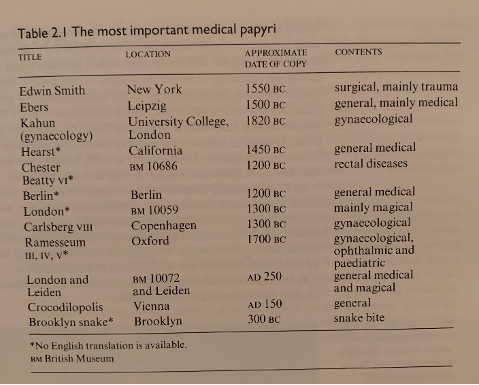
Figure 2. List of significant ancient Egyptian medical papyri. From John F. Nunn, Ancient Egyptian Medicine (Norman: University of Oklahoma Printing, 1996).
All of these papyri were composed in hieratic except Ramesseum Five, which is in cursive hieroglyphs, much like the Kahun veterinary text. Later papyri were equanimous mainly in demotic, which was the dominant script.[ten] Hieratic and cursive hieroglyphs were used at the same time and within a medical setting. Thus, they may have been understood by most physicians. Hieratic is a cursive form of Egyptian hieroglyphs that could be written quickly on papyri for administrative and literary purposes, while cursive hieroglyphs were used mainly in religious texts (including the Book of the Dead). Demotic was primarily used for administrative purposes merely over time also came to exist used for literary, science, and religious documents.[11] In that location is no clear reason why the Ramesseum V and the Kahun texts were written in a different script than the other texts. In that location is reason to believe that we only have a fraction of medical papyri that existed, as some papyri quote or allude to unknown texts.[12]
Some papyri appear to accept been handbooks for physicians, while others have outlines from lectures, record instructions including lecture notes, or were clinical notebooks owned by students.[xiii] Many simply provide remedies for diseases, listing numerous drugs available only without including much other information. These drugs are likely to have been from local plants, minerals, and animals, but some may also have been imported, such every bit lapis lazuli from Afghanistan.[14] A few of the papyri that incorporate magic explain their origins in order to plant authority and authenticity, in certain cases stating that they were plant at the pes of a statue of a god.[15] Although many of the texts accept been successfully translated, there is notwithstanding much that is unknown. Some of the vocabulary just occurs in the medical texts, while other words are well known in nonmedical settings but have specific unknown meanings in the medical context.[16]
The Edwin Smith and Ebers Papyri are the nearly well-known and informative of all the medical papyri, giving a structured method of approaching patient diagnosis and treatment. Both were purchased in 1862 by the American Edwin Smith, who lived in Luxor, Egypt, from 1858–1876 (the Ebers Papyrus was later purchased past Georg Ebers in 1872). They may accept come from the aforementioned tomb, that of a physician buried in the Theban necropolis on the west bank of the Nile.[17] The Edwin Smith Papyrus dates to circa 1600 BCE (late Middle Kingdom), with most of the linguistic communication existence in Middle Egyptian. It is generally agreed, withal, that the original dates to the Old Kingdom (ca. 2600–2500 BCE). This papyrus stands out for its content and approach to medicine, and is often referred to as the surgical papyrus. It focuses on 40-eight cases of mostly traumatic injuries and treatments of the head, face, neck, upper office of the thorax, spine, and arm.[eighteen] It follows empirical understanding, is an education book rather than simply a compilation of remedies, and only has 1 spell. Each medical instance follows the same pattern, beginning with the title "knowledge gained from practical experience: examination, diagnosis and prognosis, and handling."[19] Physical manipulations, sutures, and bandages are the chief means of treatment of injuries that were likely acquired by various types of weapons.[20]
Over time, the Edwin Smith Papyrus became one of the standard reference texts on treating trauma in ancient Egypt and the glosses that were added to fill in omissions attest to its continual utilization.[21] If the Edwin Smith Papyrus is as quondam as some scholars believe, it contains the earliest known examination of the pulse and details the parallel roles of the physician, the priest of Sekhmet, and magicians. Some scholars propose that the papyrus contains the first description of the apportionment of blood. If this is true it means that in that location was some understanding of this long before the Greek Democritus' own clarification in his treatise On Nutrition.[22] Afterwards Smith's death the papyrus was donated to the New York Historical Lodge and in 1920 the papyrus was given to Egyptologist James Henry Breasted for translation. Afterward a lengthy menstruation of written report and analysis, Breasted translated the papyrus. In 1930, he published a historic 2-volume edition containing the English translation, with medical notes prepared past physician Arno Luckhardt and an hieroglyphic transcription of the original scroll.
The Ebers Papyrus (circa 1550 BCE) is the longest medical text and is in very good condition (fig. iii).
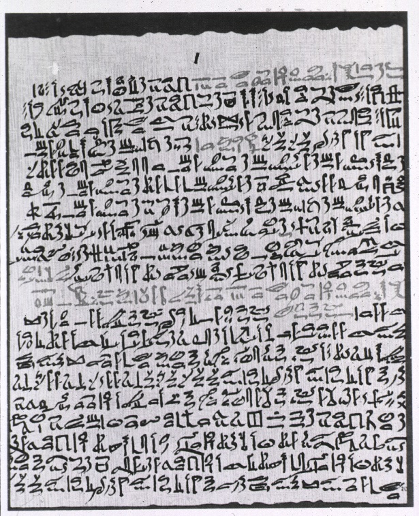
Effigy 3. A department from the Ebers Papyrus (circa 1550 BCE). From the National Library of Medicine at the U.S. National Institute of Health, http://resources.nlm.nih.gov/101436767.
This text is a compilation of original medical texts haphazardly ordered, which makes deciphering references to ailments and treatments difficult, just information technology nonetheless presents u.s. with a breadth of information. Paragraph 856a notes that the original text was "'found amongst writings of ancient times in chests of writing cloth under the feet of Anubis, in Letopolis, in the time of the majesty of the male monarch of Upper and Lower Egypt Den' (First Dynasty)."[23] This gave the text added aboriginal authority in its own time (the Berlin Papyrus makes the same statement), as the god Anubis possessed medical knowledge and was patron of embalmers. Unlike the Edwin Smith Papyrus, diseases or symptoms are frequently assumed, so only a treatment or remedy is listed. Medical problems addressed in this text include those related to the tum (fifteen diseases); the anus; the peel (18 diseases); a significant section focuses on the eye (29 diseases); and 21 treatments are provided for coughing.[24] At that place is also a notable section called The Volume of Vessels, which focuses on the metu. The metu is generally identified equally the blood vessels, ducts, tendons, muscles, and possibly the fretfulness, although it is uncertain how well the ancient Egyptians understood the nervous system. The metu may transport blood, air, mucus, semen, urine, and illness, interim every bit canals for substances to flow through. The pulse was taken regularly to make sure the metu vessels were open.[25] The end of the text is more surgical in nature and is our main source on surgery outside of trauma, listing about 700 drugs and 800 formulas.[26] There are several spells in the text and there are parallels with the Hearst, Berlin, and London papyri.[27]
Another noteworthy medical text is the Kahun gynecological papyrus. This papyrus was found by Flinders Petrie in 1889 in the Fayum area. It dates to circa 1850–1825 BCE, during Amenemhat III's reign, and is written in hieratic, although the accompanying veterinarian text is in hieroglyphic script, which is ordinarily reserved for religious texts. It is in very poor status, just yet gives us insight into ancient Egyptian'due south notions of gynecological issues, including contraception and pregnancy testing. The information does non chronicle to current gynecological understanding and at that place is nothing most obstetrics or midwives. Forth with this text, there are substantial sections of the Berlin, Carlsberg, Ebers, London, and Ramesseum papyri that accost gynecological concerns.[28]
In addition to writing medical knowledge on papyri, physicians besides wrote on ostraca, which are potsherds or flakes of generally white limestone. Due to the material used, ostraca final longer than papyri. Known medical ostraca date from the Amarna Menstruum (Eighteenth Dynasty) to the Roman occupation (30 BCE–395 CE).[29] Medical ostraca were probable used to transmit knowledge and collect treatments in texts. Frequently, medical treatments were listed 1 afterward another on these. In general, ostraca were easy to bear and were disposable. Every bit a result, there are probably many medical ostraca missing. Unfortunately, nosotros do not know who specifically used ostraca, whether all physicians did or only physicians of certain levels.
The Medical Profession
While the pharaoh was seen every bit the supreme healer, his powers were delegated to physicians, priests of Sekhmet and Serqet, and magicians who played disquisitional roles in the process of diagnosing and treating injuries and diseases. Oftentimes these roles were intertwined with one other, with some individuals having one or more of these positions. Physicians came from various social classes and the title of dr. was held in high regard.
Swnw is usually the ancient Egyptian term translated as doctor or dr. (fig. iv).
| Figure iv. Ancient Egyptian hieroglyphic variations of the give-and-take swnw. From John F. Nunn, Aboriginal Egyptian Medicine (Norman: University of Oklahoma Press, 1996). | 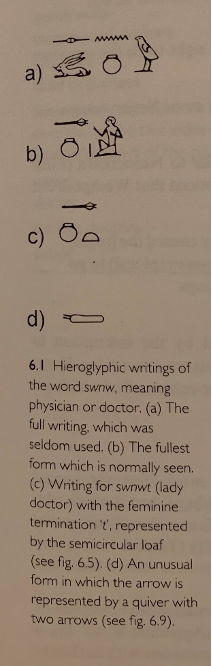 |
This title appears 150 times in tomb biographies, graffiti, stelae, and papyri dating from the Fourth Dynasty (2649–2513 BC) to the Twenty-seventh Dynasty (525–404 BCE). This is linguistically similar to the Egyptian word for pain (swny.t) and for affliction (swn).[30] One of the identifying features of the swnw in the medical papyri is the phrase "placing the paw."[31] This may have been a way of diagnosing and/or was like to "the laying on of easily" equally we say today every bit a means of healing.[32] Afterward the Twenty-7th Dynasty, when Arab republic of egypt came under Western farsi rule, swnw came to hateful both doc and embalmer.[33] Furthermore, during the Ptolemaic Period, swnw could mean embalmer equally well.[34] Previously, during the Pharaonic menstruation, there may accept been limited interactions between physicians and embalmers. Egyptologist Kent Weeks recommends that a more authentic translation of swnw should be "i who treats the ailments of the upper classes," which reflects the idea that near swnw had connections with the royal court rather than treating ordinary people.[35]
Wab (pure) priests and sau (magicians) were additional healers who used like healing techniques as swnw. Wab priests and sau are mentioned in the Edwin Smith and Ebers papyri every bit placing their hand over a patient, demonstrating their participation in healing traumatic injuries and internal ailments. The title wab can refer to even the most novice temple personnel. In the medical context, the title is usually, "wab priest of Sekhmet." The lioness goddess Sekhmet was both a destructive and healing forcefulness. Sau is ofttimes translated as wizard, but some scholars suggest that a better translation is "protector" or "amulet-man," although the latter may not be completely accurate either as information technology implies that the sau only worked with amulets, which is not the case. Sau is often used in connection with Serqet, the scorpion goddess. Like Sekhmet, this goddess also embodied subversive and healing aspects.[36]
The Court doctor formed the noon of the medical field.[37] In the Onetime Kingdom, nearly half of the known doctors and dentists had royal connections. After the Old Kingdom the number of known doctors with a royal connectedness becomes much fewer. Several swnw also had a priestly title, such as wab priest of Sekhmet, hem netjer (retainer of god), or wab nesu (royal priest). Additionally, some swnw were appointed to estates of gods, including that of Amun and Ptah, besides every bit the "Place of Truth" (the necropolis). [38] Selected physicians were sent to treat miners, workmen, or soldiers, or else were temple physicians, who were at the everyman level of the social ladder and made firm visits.[39] Physicians often associated themselves with deities who related to their specialties.[forty]
Medico Titles
While well-nigh physicians had the title swnw, there were other known related titles, including kherep swnw, meaning the near exalted "controller or ambassador of doctors." Hery swnw and imy-r mean "one with authorisation over doctors" and "overseer," respectively, while sehedj or shd swnw is translated equally "inspector." The senior physician was referred to as "Overseer of the House of Health" or "Chief of the House of Secrets," and smsw swnw meant the "eldest of doctors."[ane] The well-nigh widely held special title was wr swnw, significant "neat 1" or "principal" physician. Sometimes titles were followed by the geographic limitation of authority, such as Upper or Lower Egypt or both. Many physicians served pharaoh, often having the title swnw per aa, meaning "doctor of the Bully House or palace."
Documents propose that, much like in modern medicine, ancient Egyptian doctors had specialties.[41] For case, Herodotus famously recorded in his travels to Egypt in virtually 450 BCE that "medicine is practiced amongst them on a plan of separation; each dr. treats a unmarried disorder, and no more: thus, the country swarms with medical practitioners, some undertaking to cure diseases of the eye, others of the head, others over again of the teeth, others of the intestines, and some of those which are not local."[42] This sentiment is supported by qualifying words relating to body parts following swnw, which have been found on several stelae.[43] In addition, a number of doctors noted that they were also scribes, and some doctors were too dentists. It has been argued that swnw was primarily a dr. while surgeons may accept been referred to as "great ones of the trunk" and were mainly wab priests of Sekhmet.[44]
Physicians received years of grooming at the Peri-Ankh, or "Firm of Life," which was either within or attached to a temple and besides served as a scriptorium and library where master copies of papyri were probable held.[45] Medicine was a specialty within scribal education.[46] Surgeons received special rudimentary training. Information technology was a science and known as early as 4000 BCE, although the first record of surgical procedures was as early as 2500 BCE.[47] In addition, it appears, based on the papyri, that all physicians were expected to have basic knowledge of all types of medication bachelor.[48] In that location is indication that medical wisdom was passed down through families, equally found on stelae concerning Khay and Huy too as existence documented in the Ebers Papyrus in an obscure passage.[49]
Like other parts of the ancient Near East, such as Mesopotamia, Egypt's political structure meant that the medical field was well organized, although there was no medical licensure system.[l] Physicians were required to follow strict rules of treatment. One reason for this was that information technology was deemed that there was nil to better upon the existing wisdom of older eras. Physicians were advised to apply only the administrative texts and methods and so that their deportment would be beyond question.[51] After, Aristotle wrote that physicians were "warned by the state non to alter a course of treatment until at least four days have passed, or else be subject to legal penalties."[52] For instance, if the physician deviated within those four days he risked the penalty of decease if the patient died.
Based on the prove nosotros have, about 150 physicians are attested to from the Old Kingdom to the Belatedly Period.[53] A few notable physicians are Djer; Imhotep; Amenhotep, son of Hapu; Netjer-hotep; Hesy-ra; Pesehet; Mereuka; Ankh; Ir-en-akhty; Gua and Seni; Renef-seneb; Hery-shef-nakht; Wedja-hor-resnet; Iry; and Pentu. Imhotep ("he who comes in peace") is perhaps the nearly well-known (fig. 5).
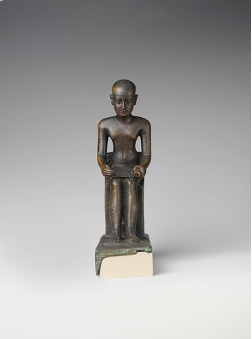 Figure 5. Statuette of Imhotep, donated by Padisu, Late Period-Ptolemaic Period (circa 664–30 BCE). Cupreous (copper-containing) metal, 17.9 cm × 5.4 cm × 12.9 cm (7 1/sixteen × 2 1/8 × five 1/xvi in.). New York Metropolitan Museum of Art, Theodore M. Davis Drove, Bequest of Theodore M. Davis, 1915, 30.eight.94.
He was the royal chamberlain of Pharaoh Djoser of the Third Dynasty and was architect of the Footstep Pyramid in addition to being a priest, astrologer, and sage. Perhaps past the Nineteenth Dynasty (circa 1295–1186 BCE, New Kingdom) and certainly by the Xx-seventh Dynasty (circa 525–404 BCE, Western farsi Dynasty), Imhotep was deified every bit the "son of Ptah," subsequently replacing Thoth every bit the chief god of healing.[54] He was the only non-royal to exist deified.[55] Miniature statues of Imhotep were sometimes worn equally amulets to protect against disease.[56] During the Ptolemaic Menstruum Imhotep was oftentimes identified with Asklepios, the ancient Greek god of medicine, simply it is not credible if Imhotep ever held the title swnw.[57]
Hesy-ra, a contemporary of Imhotep, is considered the beginning documented doctor in the globe (circa 2650 BCE), working during Djoser'due south reign. He held several titles, including wer ibeh swnw, "main of dentists and doctors."[58] According to a stela found in Akhet-hotep's Fifth or Sixth Dynasty tomb (circa 2494–2181 BCE, Onetime Kingdom), Pesehet is perhaps the starting time female md, or at to the lowest degree the beginning female overseer, of doctors. She held the titles imy-r swnwt, which could be read "[female] overseer of the female doctors," and imy-r hem-ka, "overseer of the funerary priest."[59] While she held the title of overseer, this does not necessarily mean she was a doctor herself. Pesehet remains the merely attested female person physician in ancient Egypt.[60] Hery-shef-nakht of the Twelfth Dynasty (circa 1985–1795 BCE, Eye Kingdom) uniquely held triple qualification every bit wer swnw, wab priest of Sekhmet, and overseer of magicians. These titles were recorded in the Ebers Papyrus. He besides held the important title wer swnw n nesu, master of the king's physicians.[61] Iri, a Sixth Dynasty physician, was referred to as the Keeper of the Purple Rectum and "one understanding the internal liquids" and was possibly the pharaoh'due south enema skillful.[62]
Aboriginal Egyptian physicians were well known in neighboring countries. They were regularly requested by the Hittite court.[63] For instance, Rameses Ii was asked to send a medico to the Hittite court "to ready herbs for Karunta, King of the state of Tarhuntas," according to an Akkadian text most Pariamakhu.[64] Egyptian doctors were sent to dislodge a possessing demon, to heal the Hittite rex's eye, and "to provide the rex'due south vassals 'with all sorts of prescriptions.'"[65] Rameses 2 besides wrote, "They will bring to y'all all the very skilful remedies which are here in Egypt, and which I allowed in friendly fashion to go to yous in gild to help y'all."[66] Some other request was made in which Pecker-amen, a New Kingdom doctor, received gifts for assisting a Syrian prince. Homer'southward Odyssey also references ancient Egyptian medicine, and Herodotus remarked that earlier the Farsi invasion, King Cyrus sent items to Pharaoh Ahmose II (Amasis) "for the services of the best ophthalmologist in Arab republic of egypt."[67] Foreign physicians were also allowed to practice medicine in Egypt, every bit indicated by four Babylonian physicians in New Kingdom records.[68] The Greeks expressed admiration for Egyptian medicine, specifically the effectiveness of their drugs.[69] In plough, there is bear witness that Egyptian physicians adopted medical concepts from contact with peoples in the Levant, well-nigh notably during the Eighteenth Dynasty and the Ramesside Catamenia (Nineteenth Dynasty). For instance, the Nineteenth Dynasty London Medical Papyrus incorporates 7 incantations in ii unlike languages; six are in Northwest Semitic dialects and written in syllabic Egyptian script, while one is in the Cretan linguistic communication, using syllabic Egyptian script. These prescriptions were accepted into Egyptian medical practice as legitimate remedies rather than being marginalized. Another case is a Cretan spell against an "Asiatic disease" using an Egyptian methodology from the Eighteenth Dynasty Hearst Medical Papyrus to treat the disquiet.[70]
Ailments, Injuries, and Treatments
Snake and scorpion bites, eye diseases, and gastrointestinal issues were amidst the about frequently treated ailments. Pneumonia and silicosis (inhaling dust particles), parasitic diseases, typhoid, dysentery, smallpox, and diarrhea were other mutual ailments.[71] Although they believed that people were built-in healthy, aboriginal Egyptians believed that their well-beingness was endangered by both earthly and supernatural forces, such equally through intestinal putrefaction or malignant deities entering through bodily openings and consuming vital parts of the interior of the body. Supernatural origins of affliction "could function every bit a form of punishment from the gods, a reminder of 1's social obligation or an outright assault past a malicious or arbitrary entity."[72] Particularly unpleasant remedies sometimes were prescribed that were intended to rid the body of a malignant spirit.[73] Skilful wellness was linked with living correctly, which included being at peace with the gods and spirits, likewise as the deceased.[74] Information technology was thought that affliction was due to an imbalance that could subsequently be brought back to equilibrium through prayers, spells, and rituals.
Information technology is clear from the Edwin Smith and Ebers papyri that the ancient Egyptians had a rudimentary understanding of the cardiovascular system, seeing this as a network of vessels (metu) coming from the heart and going through the torso to the organs and other torso parts. The heart was the center of the system, where "the metu delivered and received."[75] This system involved the move throughout the body of air, h2o, blood, and actual waste, termed as wekhedu. Wekhedu was a distinct focus of the ancient Egyptians.[76] The accumulation of bodily waste material sometimes appeared as pus in wounds or blisters as wekhedu worked through the blood system. Physicians sought to treat this past keeping wounds make clean and bandaged with honey and copper salts. Physicians advocated purging i'due south body and using enemas and emetics in guild to keep wekhedu from accumulating. Enemas had a divine origin as ancient Egyptians believed that Thoth invented them.[77]
It is evident from the Edwin Smith Papyrus that the brain was the location "of the nervous control of the body" and that paralysis could be considering of a encephalon injury.[78] The ancient Egyptians had an extensive noesis about the skull, brain, jaw, and face, in item. This was due in role to traumatic injuries that oftentimes occurred from industrial accidents, warfare, or creature bites.[79] Fractures were frequent injuries. Consequently, the Egyptians had an extensive set up of words describing various types of fractures, including more complicated ones.[80]
In terms of handling, it was often stated in the Edwin Smith and Ebers papyri that the doctor would either treat, "contend with," or not care for.[81] The options were based on the level of the physician'due south confidence that the injury was treatable. If a patient could not be treated, he or she was notwithstanding given care and kept comfortable until death.[82]
Views on the sources and nature of diseases ranged widely and medical classifications were made based on symptoms rather than diseases. Traumatic injuries had an obvious origin and therefore a certain ways of diagnosis and handling with some anticipated outcome.
This includes the belief that objects could exist infused with a life-force or spirit, allowing the object to deed confronting an individual, thus was the cause of the injury because the object readjusted maat.[83] Conversely, internal issues, such equally heart disease and lung ailments, had unpredictable outcomes every bit the source of illness was non always apparent. In these cases, reliance on incantations, spells, and amulets was common, sometimes in combination with drugs. If it was believed that there was a supernatural origin of the disease, such as a malign deity, the supernatural (benign deities) would be relied upon to cure the disquiet. Many deities were invoked to prevent or cure diseases or attacks by dangerous animals.[84] Incantations often took the form of directly addressing the disease or disease-demon. Incantations or prayers were also meant to reinforce the effectiveness of remedies and often were related to specific diseases and drugs.[85] They were infused with heka, which involved the component of speech.[86] Egyptians idea that the "divine artistic give-and-take and magical energy" could turn ideas into reality and therefore negate or turn away negative forces.[87] Often, spells or incantations had a "sympathetic" role; therefore, they would have been pragmatic and rational to the ancient dr..[88]
Amulets were also worn equally a means of addressing health intendance. Many amulets resembled living creatures (human or animal) or specific body parts, with the intent of the wearer assimilating the desired characteristic, such equally forcefulness or sharp eyesight. A number of people besides wore amulets to protect confronting damage, such as brute bites.[89] Information technology was thought that the material the amulet was made of and the shape of it provided protection and healing for the wearer. Even substances that came in contact with amulets were considered to have a healing effect.[xc] Amulets have been used by many people across the centuries and cultures. People still wear them today, assertive that certain objects, whether they are of natural material or human being-made, take power from a greater force, from a religious connexion, or through the mode the object was created. A rabbit's foot or other adept-luck charms are such examples.
Prescriptions made from animals, minerals, and vegetable substances were a regular means of treating diverse types of illnesses and injuries. The ancient Egyptian pharmacopeia was quite rich, although many of the terms take non still been translated.[91] The efficacy of various drugs was not always evident, since multiple drugs were often utilized simultaneously, with several elements involved, while other times drugs were used in tandem with magic. Water, alcohol (beer and wine), oil, beloved, and milk were part of preparing diverse types of prescriptions (fig. six).[92]
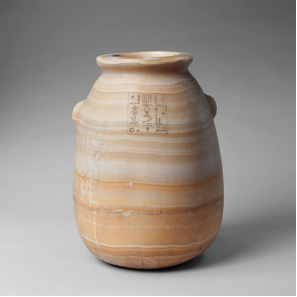
Effigy 6. Pharmaceutical jar, Saite Flow, Twenty-sixth Dynasty (570–526 BCE). The inscription lists the contents of the jar as "Special ointment of the Manager of the Red-Crown Enclaves and Chief Physician, Harkhebi." The man who owned the jar probable lived in the town of Buto in the Nile Delta. The "Cherry-Crown Enclaves" was an ancient surface area in Buto. Travertine (Egyptian alabaster), 47 × 34 cm (eighteen 1/ii × xiii 3/8 in.). New York Metropolitan Art Museum, Rogers Fund, 1942, 42.2.two.
Drugs were administered in five ways: orally, rectally, vaginally, past external application, and past fumigation. They were given in the form of cakes, suppositories, enemas, mouth rinses, tablets, drops, ointments, or special baths.[93] Oftentimes prescriptions would be fabricated based on the patient's age and weight.[94] Physicians also recited incantations while preparing or administering prescriptions.[95]
Drugs made from animals include beloved, milk, excrement, claret, urine, placenta, bile, animal fatty, meat, and liver and other internal organs. Love was an especially beneficial element for its antibacterial and antifungal backdrop, as well as being a flavorful additive to other drugs (fig. seven).
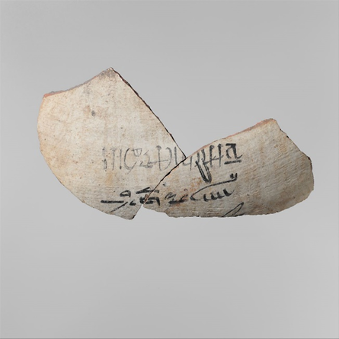
Effigy 7. Fragment of a jar with a label identifying the contents equally love. The script is in hieratic, which is written correct to left. The sign at the beginning of the 2nd line represents a bee, the symbol used for the word "love." New Kingdom, Eighteenth Dynasty (1390–1352 BCE). Pottery and ink, eight.five x fifteen.iii × 0.vii cm (iii 3/8 × 6 × 1/four in.). New York Metropolitan Art Museum, Rogers Fund, 1917, 17.x.12.
Dearest was used both internally, including helping with cough, and externally, for diverse types of wounds.[96] This is the case today every bit well. Honey is still used to help reduce coughs and sooth sore throats. It is as well beneficial in healing wounds, including burns and leg ulcers, because of its antibacterial and anti-inflammatory properties. For this reason, information technology may also help with peel grafts.[97] Milk was mainly used to make it easier to swallow other ingredients, although it was sometimes used as an enema or practical to skin, eyes, or ears.[98] Like dear, it also helped with respiratory ailments and throat irritations. Animal fat was utilized to brand a greasy ointment, but also to convey the meaningful animal characteristics, such as force.[99] For certain wounds, applying a bandage with fresh meat on the start day was full general practice. In subsequent days, bandages with honey and oil or resin would be practical, which helped the healing process.
Some mineral-based drugs that were used include natron, common common salt, malachite, lapis lazuli, imru, and gypsum. Natron was particularly beneficial in drawing out fluid and reducing swelling and was oftentimes practical with bandages. Malachite was the base for greenish eye pigment and was oftentimes used for treating centre diseases, which were widespread due to flies, dust, and sand. Malachite is a natural antibacterial and was used in cases to treat burns or inflammation. Yet, it is unclear if the ancient Egyptians recognized this belongings or if they were more than influenced by the decorative elements of the mineral.
The aboriginal Egyptians took reward of the plants and herbs available to them, including onions, mint, lettuce, barley, acacia, dates, willow, dill, aloe vera, frankincense, garlic, mustard seeds, and linseed, amongst others. Aloe vera is 1 plant we yet use to help soothe sunburns and other skin ailments. We also mint or peppermint today to help with stomach problems. Unfortunately, there is difficulty in positively identifying some of the institute species that were used. Reasons for this are that the illness for which the remedy was created cannot exist translated or is otherwise unknown; in a few cases it is unknown which office of the plant was added, or we may not know the fullness of the pharmacological effect of the establish. Some plants may at present exist extinct or have disappeared from the Nile Valley, which also hinders researchers in determining the plant species that were used.[100] Cannabis was known past the ancient Egyptians, including using hemp to make rope. It infrequently appears in the medical papyri and was administered past mouth, rectum, vagina, fumigation, on bandaged peel, and applied to the eyes. It is unknown if the Egyptians understood the effects of the institute on the nervous organization.[101] Alcohol was probable the customary means of alleviating hurting, only as it has been used in the centuries since.
Nearly a quarter of the listed prescriptions in the Ebers Papyrus were for gastrointestinal issues. Every bit previously commented, the bowels were a specific focus for the ancient Egyptians at all levels of society, as they believed that a certain toxin (wekhedu) originated at that place, which could then spread to the residue of the body and cause aging, disease, and decease.[102] They adept purging themselves on a regular ground in lodge to proceed their bodies salubrious (Herodotus noted that this occurred for three days each month).[103] Brush oil, senna, and colocynth were ofttimes consumed for this procedure, while earth almonds and tiger basics were also regularly eaten. Wormwood and pomegranate were constructive in treating intestinal parasites.
There currently is not much documentation of surgery beyond simple procedures including removing tumors, closing wounds, or treating traumatic injuries such as fractures. There are only a few examples of human remains that show that the ancient Egyptians knew of trephination to save swelling of the brain.[104] Wounds were often either closed with linen sutures, equally observed in seven cases in the Edwin Smith Papyrus, or bandaged with linen.[105] Surgery deep inside the trunk was generally non practiced considering of the lack of an coldhearted.[106] Some surgical instruments referenced in the medical papyri are lancets, tweezers, drills, claw-like instruments, retractors, and dental tools (fig. eight).
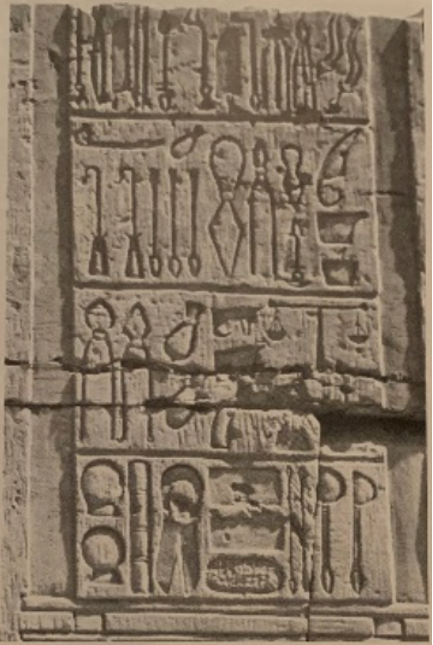
Figure viii. Prototype of medical instruments chiseled on the inner part of the northern section of the outer enclosure wall of the temple of Kom Ombo (Roman era). Kom Ombo is north of Aswan in southern Egypt. From John F. Nunn, Ancient Egyptian Medicine (Norman: University of Oklahoma Printing, 1996).
Bronze was initially widely implemented but afterward copper was the preferred metal.
Snakes were much dreaded in ancient Egypt. While the Edwin Smith Papyrus does not address how snake bites were treated and the Ebers Papyrus simply minimally addresses this, the Brooklyn Museum Papyri focuses on this subject. The extant copy of the text dates to circa 6th-fourth century BCE, although the original may engagement as early on as the Onetime Kingdom.[107] The papyri identify at least twenty-one snakes and one chameleon. Information technology also provides a brief description of the effects of the different types of snake bites, forth with the prognosis. Care included local treatment of the bite, drugs (mainly herbal), and incantations. Many of these treatments intended to accost hurting and swelling as opposed to preventing the full general absorption of the venom. There are several suggestions of applying bandages, which would have helped with applying localized drugs. Onion was one of the primary ingredients for treating bites, which was often part of a compound with salt and sugariness beer, and at times was utilized along with incantations. Emetics were also prescribed, as the theory was to miscarry the venom through vomiting. The kherep priests of Serqet were the primary healers in preventing and treating snake bites as well as scorpion stings.[108]
Ancient Arab republic of egypt's Influence on Greek Medicine
Not long after Alexander the Slap-up invaded Egypt in 332 BCE, the famous Alexandrian medical school was established, which had a dandy bear on during the Ptolemaic, Roman, and Coptic periods. Many Greek physicians studied there, including Herophilus and Galen. Pliny the Elder, the Roman naturalist, asserted that the fine art of medicine may have been invented by the Egyptians.[109] Scholars have long debated the extent to which the Egyptians may have influenced aboriginal Greek medicine.
The following is what some scholars merits equally being among the contributions. The Greek physician Herophilus, who studied in Alexandria, adopted the technique of pulse-taking every bit adult by the Egyptians. In add-on, the practice of mummification immune for anatomical autopsy, which was otherwise taboo in ancient Greece. The Pre-Alexandrian Hippocratic Corpus illustrates parallels with Egyptian ideas and practices, such equally birth prognoses adapted from pregnancy texts found in the Kahun, Carlsberg, and Berlin papyri, as well as disorders of the womb.[110] Some of the Greek gynecological, and possibly surgical, techniques may also be attributed to ancient Egyptians.[111] A few Egyptian terms were too adopted into Greek, such as that for migraine.[112] The four humors in Greek thinking may have besides first come from Egypt.[113]
In addition, we know that the Greeks imitated and further developed the do of empirical examination of patients, including diagnosis and prognosis.[114] The practice of incubation (sleeping in a sacred expanse with the purpose of experiencing divine dreams or healing) may also have originated with the Egyptians.[115] There is textual evidence that this practice existed at Deir el-Medina during the New Kingdom, circa 1200 BCE, and that temples at Sais and Heliopolis were well-known medical centers in the Heart Kingdom, circa 1900 BCE.[116]
1 of the nearly noteworthy aboriginal Egyptian contributions to Greek, and later Roman, medicine is pharmaceuticals. The symbol for prescription, Rx, is Latin for "recipe," meaning "accept," and may have originated from the Eye of Horus (fig. nine), which was an especially significant component of ancient Egyptian medicine, as it was believed that it had power to heal and protect.

Figure 9. Stamp seal in the shape of Wedjat-Heart (Heart of Horus), New Kingdom, Eighteenth Dynasty (1400–1390 BCE). Steatite (glazed), 1.vii × 1.i × 0.6 cm (11/16 × 7/16 × 1/4 in.). New York Metropolitan Art Museum, souvenir of Helen Miller Gould, 1910, 10.130.208.
It too served to measure prescriptions, as the mathematical proportions of the center were used to determine the amount of ingredients in medicines. The eye was divided into six parts related to the six senses: touch, gustation, idea, hearing, sight, and odor.[117] In addition, many drugs and vegetable substances termed "Egyptian" played a prominent role in Greek and Roman medicine, every bit found in Greek medical works such as the Hippocratic Corpus and in the works of Herophilos, Dioscurides, Galen, and Pliny. The Odyssey also refers to Helen of Troy dispensing a drug to soothe her guest, where it is said to have been a souvenir from an Egyptian woman, and she praises Egyptian physicians as beingness "knowledgeable across all humans."[118] Pharmaceutical contributions include natron, aloe, chicory, alum, beans, castor oil, comfrey, pomegranate, saffron, and other oils and perfumes. The most pop was natron, equally information technology is a naturally occurring soda that is used for cleansing purposes. The administration of drugs was also influenced by the Egyptians. Greek physicians at the Alexandrian medical school were the get-go to quantify specific ingredients in remedies, mimicking the precision of the Egyptians. I markedly influential prescription ingredient was the "milk of a adult female who has borne a male child," which was "sympathetically evoking the curative milk of Isis after the nascency and injury of [her son] Horus" (fig. 10).
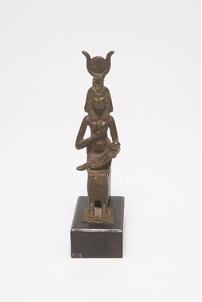
Figure 10. Isis and the infant Horus, circa 300 BCE, Ptolemaic Kingdom (332 BCE–xxx CE). Bronze and wood, 16.51 cm (vi.5 in.). Spencer Museum of Art, University of Kansas, gift of Dr. Franklin D. Murphy, 1956.0029.
This chemical element can be found several times in Egyptian texts and afterward was recommended in the Hippocratic Corpus, by Pliny and Dioscorides, in Coptic medicine, and in British herbals from the twelfth through seventeenth centuries. Brush oil was another prescribed drug that is still used today.[119] Conversely, in afterwards Egyptian medical papyri new drugs appear, and while they are transcribed in Egyptian, they originated from someplace else.[120]
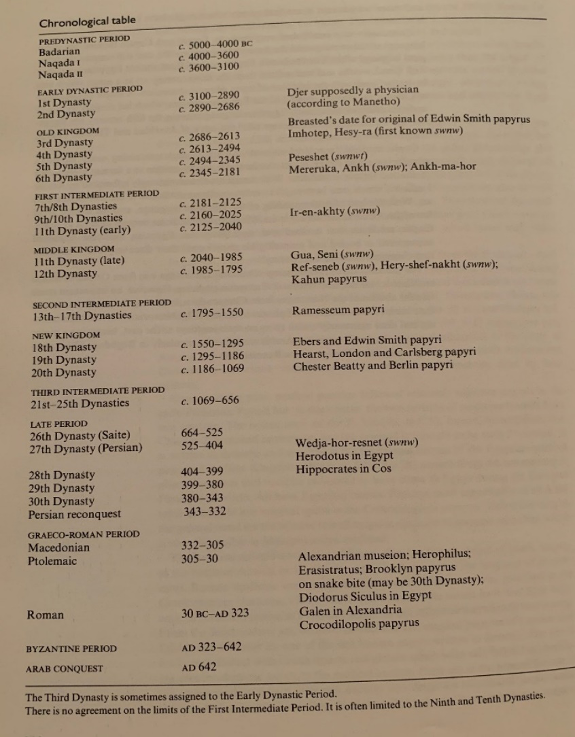
Chronology of ancient Egyptian dynasties, notable physicians, and medical papyri. From John F. Nunn, Ancient Egyptian Medicine (Norman: Academy of Oklahoma Printing, 1996).
Bibliography
Aboelsoud, North. H. "Herbal Medicine in Aboriginal Egypt." Journal of Medicinal Plants Research 4, no. 2 (2010): 82–86.
Allen, James P. "The Art of Medicine in Ancient Egypt." In The Fine art of Medicine in Aboriginal Egypt. New York: The Metropolitan Museum of Art, 2005, nine–12.
Carrick, Paul. Medical Ethics in the Ancient World. Washington: Georgetown Academy Press, 2001.
Escolano-Poveda, Marina. "Demotic: Opening New Windows into the Understanding of Egyptian History and Culture." ARCE, American Enquiry Center in Egypt. October 20, 2020. https://www.arce.org/resource/demotic-opening-new-windows-understanding-egyptian-history-and-culture#:~:text=The%20term%20%E2%fourscore%9CDemotic%E2%80%9D%20refers%20to,language%20of%20the%20New%20Kingdom.
Gross, Charles. "From Imhotep to Hubel and Wiesel: The Story of Visual Cortex." In Encephalon, Vision, Memory: Tales in the History of Neuroscience. Cambridge, MA: MIT Press, 1998, 1–xc.
Horstmanshoff, H. F. J., and Marten Stol, eds. Magic and Rationality in Ancient Well-nigh Eastern and Graeco-Roman Medicine. Leiden: Brill, 2004.
Longrigg, James. Greek Rational Medicine: Philosophy and Medicine from Alcmaeon to the Alexandrians. London: Routledge, 1993.
Meo, Sultan Ayoub, Saleh Ahmad Al-Asiri, Abdul Latief Mahesar, and Mohammad Javed Ansari. "Role of Honey in Modern Medicine." Saudi Journal of Biological Sciences 24 no. 5 (2017): 975–78.
Mininberg, David T. "The Legacy of Ancient Egyptian Medicine." In The Art of Medicine in Aboriginal Egypt. New York: The Metropolitan Museum of Art, 2005, 9–12.
Nicolaides, Angelo. "Assessing Medical Do and Surgical Engineering science in the Egyptian Pharaonic Era." Medical Technology SA 27, no. 1 (2013): xix–25.
Nunn, John F. Aboriginal Egyptian Medicine. Norman: University of Oklahoma Press, 1996.
Porter, Roy. The Greatest Do good to Mankind: A Medical History of Humanity. New York: Westward.Westward. Norton Co., 1997.
Ritner, Robert 1000. "Innovations and Adaptations in Ancient Egyptian Medicine." Journal of Almost Eastern Studies 59, no. 2 (2000): 107–17.
Saber, Aly. "Ancient Egyptian Surgical Heritage." Periodical of Investigative Surgery 23, no. half-dozen (2010): 327–34.
Saunders. J. B. de C. M. The Transitions from Aboriginal Egyptian to Greek Medicine. Lawrence, KS: University of Kansas Press, 1963.
"Snakebite Papyrus." Brooklyn Museum. https://world wide web.brooklynmuseum.org/opencollection/objects/124173.
Sullivan, Richard. "A Brief Journey into Medical Care and Disease in Aboriginal Arab republic of egypt." Journal of the Royal Society of Medicine 88, no. 7 (1995): 141–45.
Zucconi, Laura G. "Medicine and Religion in Ancient Egypt." Faith Compass 1, no. 1 (2007): 26–37.
Suggested Further Reading
Ghaliounghui, Paul. The House of Life: Magic and Science in Ancient Arab republic of egypt. 2nd ed. Amsterdam: B.M. Israël, 1973.
Ghaliounghui, Paul. The Physicians of Pharaonic Arab republic of egypt. Cairo: Al-Ahram Center for Scientific Translations, 1983.
Grapow, Herman, and Hildegard von Deines. Grundriss der Medizin der Alten Ägypter. Berlin: Akademie-Verlag, 1954.
Halioua, Bruno, and Bernard Ziskind. Medicine in the Days of the Pharaohs. Trans. Yard.B. DeBevoise. Cambridge, MA: The Belknap Press of Harvard University Printing, 2005.
Jonckheere, Frans.Les Médicines de 50'Egypte Pharaonique: Essai de Prosopographie. Brussels: Éditions de la Fondation Éqyptologique, 1958.
Laskaris, Julie. The Fine art Is Long: On the Sacred Disease and the Scientific Tradition. Leiden: Brill, 2002.
Lefebvre, Gustave. Essai sur la Médecine Égyptienne de l'Époque Pharaonique. Paris: Presses
Universitaires de French republic, 1956.
Majno, Guido. The Healing Paw: Human and Wound in the Ancient Earth. Cambridge, MA: Harvard University Press, 1975.
Manniche, Lise. An Ancient Egyptian Herbal. Austin: Academy of Texas Press, 1989.
Saba, Magdi K., Hector O. Ventura, Mohamed Saleh, and Mandeep R. Mehra. "Aboriginal Egyptian Medicine and the Concept of Heart Failure." Journal of Cardiac Failure 12, no. 6 (2006): 416–21.
Westendorf, Wolfhart. Handbuch der altägyptischen Medizin. Leiden: Brill, 1999.
[1]. Laura Thou. Zucconi, "Medicine and Religion in Ancient Egypt," Religion Compass 1, no. 1 (2007): 26.
[2]. Zucconi, "Medicine and Religion," 27.
[3]. Zucconi, "Medicine and Religion," 28.
[4]. Zucconi, "Medicine and Religion," 28.
5. John F. Nunn, Ancient Egyptian Medicine (Norman, OK: Academy of Oklahoma Printing, 1996), 115.
[6]. Zucconi, "Medicine and Religion," 36; and Roy Porter, The Greatest Benefit to Flesh: A Medical History of Humanity (New York: W.W. Norton Co., 1997), 49.
[seven]. Richard Sullivan, "A Brief Journeying into Medical Care and Disease in Ancient Egypt," Periodical of the Royal Order of Medicine 88, no. 7 (1995): 141–42.
[viii]. Angelo Nicolaides, "Assessing Medical Exercise and Surgical Technology in the Egyptian Pharaonic Era," Medical Technology SA 27, no. 1 (2013): 19.
[9]. Zucconi, "Medicine and Organized religion," 26.
[ten]. Nunn, Ancient Egyptian Medicine, 23, 24, 39.
[12]. Nunn, Aboriginal Egyptian Medicine, 24; and Robert 1000. Ritner, "Innovations and Adaptations in Ancient Egyptian Medicine," Periodical of Nearly Eastern Studies 59, no. ii (2000): 108.
[13]. Rosalie David in H. F. J. Horstmanshoff and Marten Stol, eds., Magic and Rationality in Ancient About Eastern and Graeco-Roman Medicine (Leiden: Brill, 2004), 140.
[14]. Nunn, Ancient Egyptian Medicine, 138.
[xv]. Nunn, Ancient Egyptian Medicine, 104.
[xvi]. Nunn, Ancient Egyptian Medicine, 25, 68.
[17]. Nunn, Aboriginal Egyptian Medicine, 30.
[18]. James P. Allen, "The Fine art of Medicine in Ancient Arab republic of egypt," in The Art of Medicine in Ancient Egypt (New York: Metropolitan Museum of Art, 2005), 11.
[19]. Nunn, Ancient Egyptian Medicine, 26–30; and Allen, "The Art of Medicine in Ancient Egypt," 9.
[xx]. Zucconi, "Medicine and Religion," 27; and Allen, "The Art of Medicine in Aboriginal Egypt," 9.
[21]. Nunn, Aboriginal Egyptian Medicine, 26–xxx.
[22]. Sullivan, "A Brief Journey," 141.
[23]. Nunn, Ancient Egyptian Medicine, 31, 38; and J. B. de C. Thousand. Saunders, The Transitions from Ancient Egyptian to Greek Medicine (Lawrence, KS: University of Kansas Printing, 1963).
[24]. Porter, The Greatest Benefit, 48.
[25]. Zucconi, "Medicine and Religion," 28.
[26]. Porter, The Greatest Benefit, 48.
[27]. The majority of the information in this paragraph comes from Nunn, Ancient Egyptian Medicine, xxx–34.
[28]. All Information in this paragraph comes from Nunn, Ancient Egyptian Medicine, 34–35.
[29]. Nunn, Ancient Egyptian Medicine, 41.
[30]. Zucconi, "Medicine and Religion," 35.
[31]. Nunn, Ancient Egyptian Medicine, 115.
[32]. Nunn, Aboriginal Egyptian Medicine, 115.
[33]. Nunn, Aboriginal Egyptian Medicine, 115, 134.
[34]. Nunn, Ancient Egyptian Medicine, 44.
[35]. Robert Arnott in H. F. J. Horstmanshoff and Marten Stol, eds., Magic and Rationality in Ancient About Eastern and Graeco-Roman Medicine (Leiden: Brill, 2004), 156n7.
[36]. Information in this paragraph from Zucconi, "Medicine and Religion," 34.
[37]. Porter, The Greatest Benefit, 49.
[38]. The majority of the information in this paragraph comes from Nunn, Ancient Egyptian Medicine, 116–118, 120.
[39]. Nicolaides, "Assessing Medical Practice," 21.
[40]. Sullivan, "A Brief Journey," 142.
[41]. Nunn, Ancient Egyptian Medicine, 11.
[42]. Paul Carrick, Medical Ethics in the Aboriginal Earth (Washington: Georgetown University Press, 2001), 15. Porter also cites a similar quote; meet The Greatest Do good, 49.
[43]. Nunn, Ancient Egyptian Medicine, 119.
[44]. Nicolaides, "Assessing Medical Practise," 20; and Nunn, Ancient Egyptian Medicine, 119.
[45]. Nicolaides, "Assessing Medical Practice," 21; and David, Magic and Rationality, 138.
[46]. David T. Mininberg, "The Legacy of Aboriginal Egyptian Medicine," in The Art of Medicine in Ancient Egypt (New York: Metropolitan Museum of Art, 2005), 13.
[47]. Nicolaides, "Assessing Medical Exercise," 19, 22.
[48]. Nicolaides, "Assessing Medical Practice," 21.
[49]. Nunn, Ancient Egyptian Medicine, 130–131.
[50]. Porter, The Greatest Benefit, 50.
[51]. Nicolaides, "Assessing Medical Practice," 21.
[52]. Carrick, Medical Ethics, 72.
[53]. Ritner, "Innovations and Adaptations," 116.
[54]. Nunn, Ancient Egyptian Medicine, 122; and Nicolaides, "Assessing Medical Practice," 20.
[55]. Nicolaides, "Assessing Medical Practice," 20.
[56]. Charles Gross, "From Imhotep to Hubel and Wiesel: The Story of Visual Cortex," in Brain, Vision, Memory: Tales in the History of Neuroscience (Cambridge, MA: MIT Press, 1998), 5.
[57]. Nunn, Ancient Egyptian Medicine, 122; and Allen, "The Fine art of Medicine," 12.
[58]. Nunn, Ancient Egyptian Medicine, 124.
[59]. Nunn, Ancient Egyptian Medicine, 124.
[threescore]. Ritner, "Innovations and Adaptations," 117; and Porter, The Greatest Benefit, 49.
[61]. Nunn, Ancient Egyptian Medicine, 128.
[62]. Porter, The Greatest Benefit, 49; and Nicolaides, "Assessing Medical Practice," 21.
[63]. Ritner, "Innovations and Adaptations," 111; and Arnott, Magic and Rationality, 169.
[64]. Nunn, Ancient Egyptian Medicine, 131.
[65]. Ritner, "Innovations and Adaptations," 112.
[66]. Ritner, "Innovations and Adaptations," 112.
[67]. Nunn, Ancient Egyptian Medicine, 132; and James Longrigg, Greek Rational Medicine: Philosophy and Medicine from Alcmaeon to the Alexandrians (London: Routledge, 1993), 228n2.
[68]. Most information in this paragraph comes from Nunn, Aboriginal Egyptian Medicine, 131–32.
[69]. Carrick, Medical Ethics, fifteen.
[70]. Ritner, "Innovations and Adaptations," 111.
[71]. Nicolaides, "Assessing Medical Practise," 20.
[72]. Zucconi, "Medicine and Organized religion," twenty.
[73]. David, Magic and Rationality, 141.
[74]. Porter, The Greatest Benefit, 49.
[75]. Nicolaides, "Assessing Medical Practice," 21.
[76]. Ritner, "Innovations and Adaptations," 114.
[77]. Porter, The Greatest Benefit, 49.
[78]. David, Magic and Rationality, 144.
[79]. Nunn, Ancient Egyptian Medicine, 50.
[80]. Nunn, Ancient Egyptian Medicine, 57.
[81]. Nunn, Aboriginal Egyptian Medicine, 114.
[82]. Carrick, Medical Ethics, 74.
[83]. Zucconi, "Medicine and Faith," 30.
[84]. Nunn, Ancient Egyptian Medicine, 96.
[85]. Nunn, Ancient Egyptian Medicine, 105.
[86]. Zucconi, "Medicine and Religion," 32.
[87]. David, Magic and Rationality, 134.
[88]. Ritner, "Innovations and Adaptations," 113.
[89]. Nunn, Ancient Egyptian Medicine, 110.
[90]. Allen, "The Art of Medicine," x.
[91]. Nunn, Ancient Egyptian Medicine, 144.
[92]. Nunn, Ancient Egyptian Medicine, 139–40.
[93]. Nicolaides, "Assessing Medical Practice," 21.
[94]. Nicolaides, "Assessing Medical Practice," 22; and N. H. Aboelsoud, "Herbal Medicine in Ancient Egypt," Journal of Medicinal Plants Research 4, no. 2 (2010): 84.
[95]. Aboelsoud, "Herbal Medicine in Ancient Egypt," 82.
[96]. Nunn, Ancient Egyptian Medicine, 148.
[97]. Sultan Ayoub Meo, Saleh Ahmad Al-Asiri, Abdul Latief Mahesar, and Mohammad Javed Ansari, "Role of Dear in Modernistic Medicine," Saudi Journal of Biological Sciences 24 no. 5 (2017): 977.
[98]. Nunn, Ancient Egyptian Medicine, 148.
[99]. Nunn, Aboriginal Egyptian Medicine, 149–l.
[100]. Nunn, Aboriginal Egyptian Medicine, 151.
[101]. Nunn, Ancient Egyptian Medicine, 156.
[102]. Nunn, Ancient Egyptian Medicine, 158.
[103]. Porter, The Greatest Benefit, fifty.
[104]. Nunn, Ancient Egyptian Medicine, 169.
[105]. Nunn, Ancient Egyptian Medicine, 171 and 173; and Mininberg, "The Legacy of Aboriginal Egyptian Medicine," 14.
[106]. Nicolaides, "Assessing Medical Practice," 22.
[108]. All information in this paragraph is from Nunn, Ancient Egyptian Medicine, 188–89, 99–100.
[109]. Longrigg, Greek Rational Medicine, 229n17.
[110]. Longrigg, Greek Rational Medicine, xi.
[111]. Longrigg, Greek Rational Medicine, 10.
[112]. Nearly data in this paragraph is from Ritner, "Innovations and Adaptations," 115–xvi.
[113]. Carrick, Medical Ethics, 15–16.
[114]. Carrick, Medical Ethics, 15.
[115]. Longrigg, Greek Rational Medicine, 10.
[116]. David, Magic and Rationality, 143.
[117]. Aly Saber, "Ancient Egyptian Surgical Heritage," Periodical of Investigative Surgery 23, no. six (2010): 333.
[118]. Longrigg, Greek Rational Medicine, 10; and Arnott, Magic and Rationality, 183.
[119]. Much of the information in this paragraph, including the quote about milk, is from Ritner, "Innovations and Adaptations," 116.
[120]. David, Magic and Rationality, 145.
Source: https://press.rebus.community/historyoftech/chapter/ancient-egyptian-medicine/
0 Response to "The Art of Medicine in Ancient Egypt James P Allen"
ارسال یک نظر